
Written by David Morgan. Posted on June 22, 2025 as “Lost at sea: nearly 300 dead on their journey for a new life” by insidecroydon
The great migration from Britain during the 19th and early 20th centuries saw many Croydon residents uproot their lives and seek pastures new. The lure of the wide-open spaces, opportunities and better prospects in Australia, America and Canada proved irresistible. But such dreams didn’t always come to fruition.
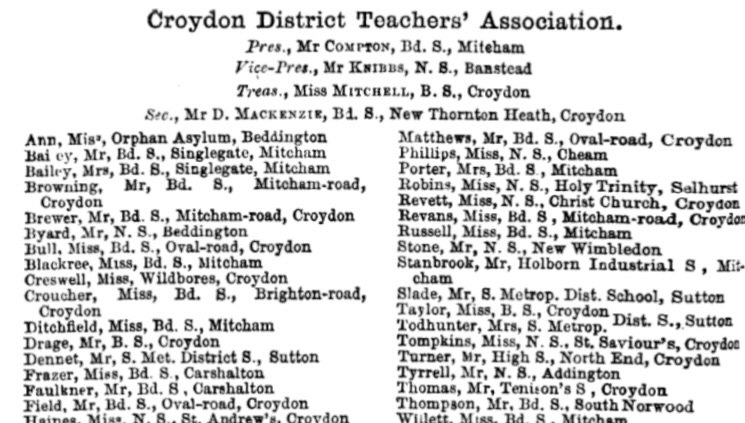
The excitement in the Field household in Croydon in 1886 would have been mounting through the year. Once the decision was made to emigrate to Australia, the family began to make plans. William Field, a member of the Croydon District Teachers’ Association, was the master of Oval Road Board School. He had to hand in his notice. Better prospects in Perth, Western Australia, had persuaded him to book his family’s passage. His wife and two children began the task of deciding what to take with them. Finally, all was ready. They travelled up to London to board the ship which would take them 9,000 miles to Fremantle. William, Ann, Kate and Henry Field boarded the SS Kapunda on December 11, 1886.
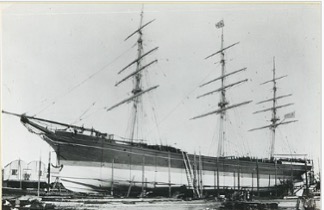
The Kapunda was a purpose-built ship for the Australian emigration run, which it had done on several occasions. Constructed on the Clyde in 1875, the iron-hulled sailing ship was captained by John Masson, an experienced mariner who had worked for the ship’s owners Trinder, Anderson and Co for many years. The ship, chartered by the Crown Agents, sailed out of London and down through the Channel to Plymouth, where more passengers were taken on board.
The majority of passengers were in “steerage”, their cheap fares enabling them to sail towards their dreams. Each passenger on board travelling at reduced rates needed to have been nominated by somebody already living in Australia, in order to qualify for the discount. Thirty passengers were travelling under the auspices of the Western Australian Land Company, which wanted to build a 200-mile railway from Beverley to Albany at King George’s Sound. By the terms of their concession, the company was bound to settle a certain number of immigrants in return for large grants of land.
When the Kapunda sailed out of Plymouth on December 18, there were 313 people on board, 268 of them in steerage. One would-be emigrant was unable to travel because of a broken arm sustained the day before departure. Another family had to give up their places because of a last-minute illness. There were 41 crew. The Field family of four from Croydon were the only cabin passengers on the ship. They were paying in full for their voyage. There weren’t many cabins on board, but it was unusual that only one was occupied.
After leaving Plymouth, the Kapunda made good speed across the Atlantic, the crew and passengers celebrating Christmas on board before crossing the Equator after 27 days at sea. On the evening of January 19, sailing off the coast of Brazil, an onboard theatrical entertainment was organised, followed by a dance on deck. The tropical night was bright and fine and the festivities went on until the early hours. Eventually, the passengers returned to their accommodation leaving the chief officer, Cotterell, on watch. There was no moon but the sidelights of the Kapunda were burning brightly.
At 3.20 in the morning, a dark shape loomed off the port side. So quickly did events unfold that the chief officer had no time to take evasive action. The Kapunda was smashed into by the Ada Melmore, a ship loaded with manganese which was sailing from Chile to Britain. The Kapunda was severely holed below the waterline. The foremast and rigging were smashed and crashed onto the deck. There was no time even to launch a lifeboat, despite the chief officer’s cries. The Kapunda quickly went under the waves. Some reports said that the ship sank in 16 seconds. Of the 313 people on board, only 16 survived.The list of names of the survivors did not include any of the Field family.
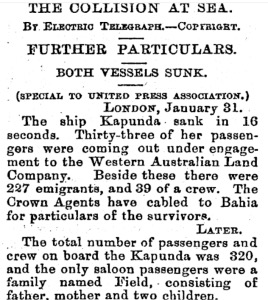
Two crew members of the Ada Melmore also died. They had jumped or fallen onto the deck of the Kapunda after the impact and were subsequently lost. So quickly did the Kapunda sink that the chief officer was taken down with her into the black waters. Being a strong swimmer, he managed to fight his way to the surface, where he saw very little debris that he might cling on to. After managing to survive in the water for about an hour, he was spotted by a small boat which had been launched by the Ada Melmore and dragged aboard. Cotterell, the chief officer, soon began to understand the extent of the catastrophe which had happened. Six other men who struggled in the water managed to reach an upturned boat which had floated from the Kapunda when she sank. They were pulled to safety by one of the small boats searching for survivors. Nine others had jumped on to the Ada Melmore just after the impact and survived on the deck of the cargo vessel or by hanging on to ropes. The handful of rescued people must have made a pitiful sight.
Of the 16 survivors, eight were crew members and eight were passengers. The Ada Melmore managed to limp to the coast of Brazil, but that was the final journey for that ship, too. After the Kapunda tragedy, sailing ships were never used again to convey emigrants to Australia. In the days after the collision, the survivors talked about the cargo ship not being correctly lit and how it had actually turned into the Kapunda when an impact might have been avoidable.
One story emerged about a young woman who was due to sail on the Kapunda but didn’t take up her passage because of the intervention of her mother after she had nightmares about a sinking ship. Louisa Benn, aged 18, lived with her mother in Queen Street, Wednesbury, in the West Midlands. Despite the opposition of her family and friends, Benn determined that she would emigrate to Western Australia. She left Wednesbury and travelled down to Plymouth, where she was to join the Kapunda. That night, her mother had a nightmare in which she saw a ship sinking and heard the screams of those on board. The next evening, the old lady fell asleep and had another terrible dream about a sinking ship, but this time she was sure she heard her daughter calling out, “Oh mother save me!”
Louisa Benn was to sail the next day and she was already on board the doomed ship when she received “an imploring message” from her mother not to go ahead with the voyage. The ship’s doctor teased Benn that if every anxious mother got their way, then it would be an expensive business, as the passenger’s baggage had already been stowed and she wouldn’t get it back if she decided not to sail. Another officer, listening to the conversation, was in a much more empathetic mood. He described the hurt and pain that would be felt by her mother and encouraged Louisa to return home. Louisa Benn returned to Wednesbury feeling both foolish and angry. It was said she led her mother “a life of it”, until a little more than a month later she heard the devastating news of the Kapunda’s loss, which left friends and family of passengers such as the Fields to grieve at their lives lost.
David Morgan is a former Croydon headteacher, now the volunteer education officer at Croydon Minster who offers tours or illustrated talks on the history around the Minster for local community groups. If you would like a group tour of Croydon Minster or want to book a school visit, then ring the Minster Office on 020 688 8104 or go to the website on www.croydonminster.org and use the contact page
 East Croydon Community Organisation