

Behind The Cricketers on Addiscombe Road, there is one of Croydon’s early electricity substations. Its façade is partially obscured by the pub’s kitchen extension and sometimes by parked cars. The full extent of the building can best be appreciated from Addiscombe Court Road.
This webpage places the substation above in its historical context. It is a tribute to the South Norwood Tourist Board for their joyous questioning of the status quo and effective community activism. Founded as an anarchist collective (by Ian Bone, Jason Cooper, Lou Cooper, Paul Dovey, Richard Lammy and Jane Nicholl), in 2012 they conducted a walk entitled “Danger of Death” in which they visited over twenty local electricity substations.
Many thanks, also, to Tony Skrzypczyk for drawing my attention to several of the substations featured below and providing me with additional information at short notice. The photographs below were taken by Angela Vanegas (in the style of Hilla & Bernd Becher) as part of a beginner’s photography course taught by Philip Bedford at Croydon Clocktower for CALAT (https://www.calat.ac.uk ).
A brief history of electricity substations in Croydon
In the late 19th century, many street and homes in Croydon were illuminated by gas lights. However, by May 1892, there were already more than 40 private, small-scale electrical installations in Croydon. These included Brickwood House on Addiscombe Road where James Webster Prince had 66 incandescent lamps installed in 1887.
It was not until November 1896, that the first public electric power station in Factory Lane was declared open. The Mayoress, Mrs F. T. Edridge, turned on a switch that that lit a large arc light in the room and street lamps in the main streets of the centre of town. Initially, the underground mains led to five substations, each distributing current to its own section of the network. Four of these were in specially constructed buildings: in Market Street, Station Road, Mint Walk and Wellesley Road (two above and two below ground, none of which appear to have survived). The fifth was in an existing building in St James Road (below). It was not unusual to commandeer existing buildings for such use. Listed substations elsewhere include those in a 16th century chapel in Skipton and an early 19th century hearse house in Runcorn.

In 1897 there was a recommendation to extend the mains to Southbridge Road. Land on the road was leased from the brewers Nalder & Collyer for the erection of a substation (below). This building is very similar to a substation at Reeves Corner, on the way from the power station in Factory Lane, as well as the one behind The Cricketers. The latter was probably built around the same time, as the mains had been extended along Addiscombe Road as far as Radcliffe Road by 1898. The facades of these two feature the remnants of window frames and it seems likely that the substation in Southbridge Road would also have functional windows, later bricked in.

By 1901 electricity was distributed via 26 substations in Croydon to nearly 800 customers and the power station also provided electricity for trams. Some 400 street lamps could be switched on over 12 sq miles, an area that included South Norwood. This may have been when the substation on Tennison Road (below) was constructed. A similar substation can be found in Dalmally Alley, which bisects Addiscombe Railway Park.

Not all substations were built in such a utilitarian style. The Whitehorse Road substation (below) mirrors the form of the late 19th century West Croydon Baptist Church opposite. However, its stone pilasters and upper door frame are in Art Deco style, and the building was probably constructed in the inter-war years. It seems to have been built to augment an existing substation immediately to the south, a smaller version of that in Tennison Road. In Tooting Bec, an earlier substation had been built in French Gothic style to complement the nearby Church of the English Martyrs.

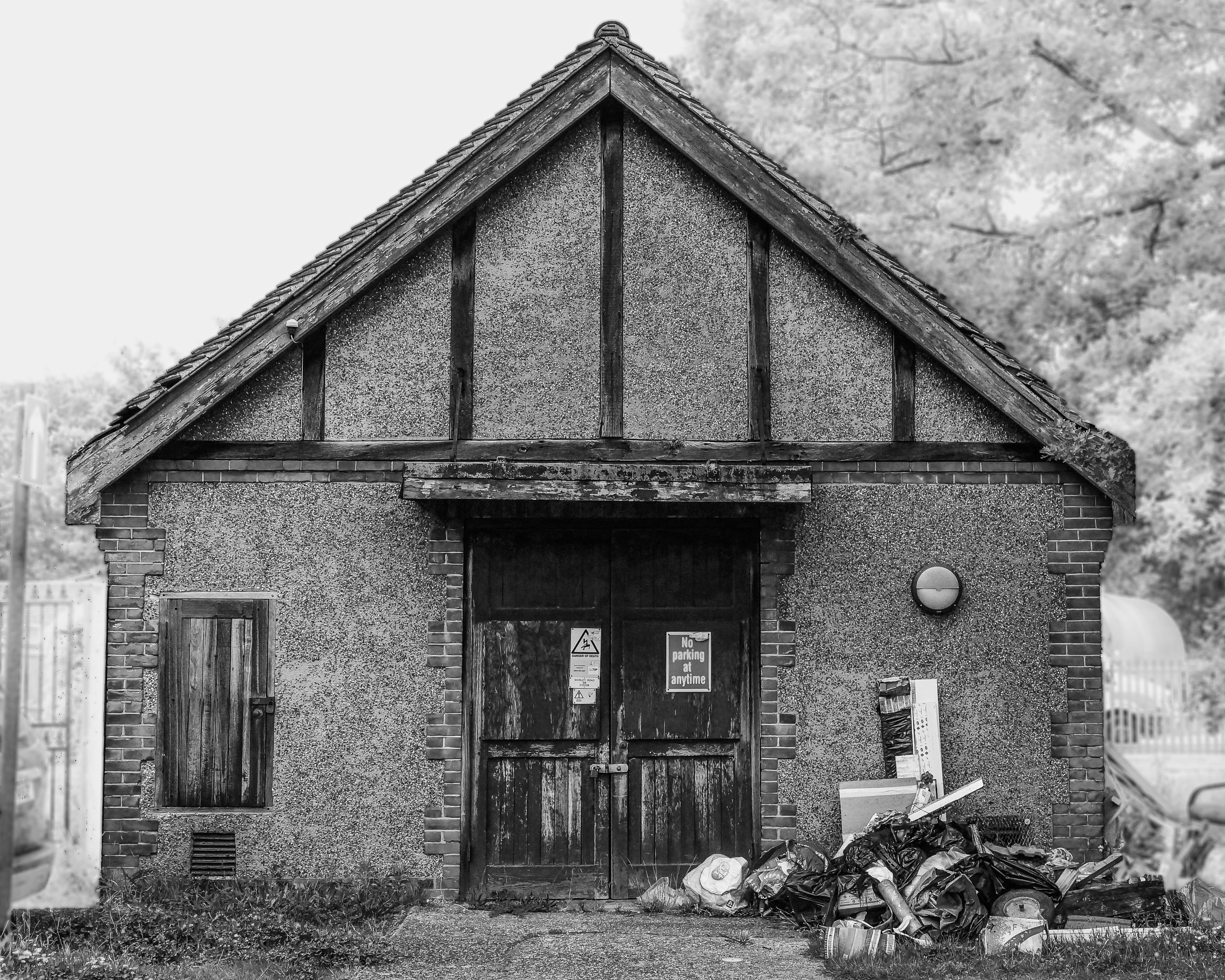
Smaller Croydon substations of the interwar period were more likely to be designed in a more modest Tudor Bethan style, such as the one on Primrose Lane, off Shirley Road (below). Similar examples can be found on Addiscombe Grove (to the side of the Easy Hotel) and in Mapledale Avenue (next to the pond). However, the finest mock Tudor substation of all is that built in 1925 in the centre of Soho Square, central London. A comparison can be made to the interwar substations in Wolverhampton .
The 1950s and 1960s saw a move to the construction of Modernist substations, where some of the equipment was left unhoused, the rest enclosed in plain brick buildings. The substation in Courtwood Lane (below) exemplifies this trend, and was probably built in the 1960s when the surrounding Forestdale Estate was developed. A similar example can be found on the northern edge of Brickfields Meadow. On 30 April 2013 South Norwood Tourist drew attention to it on their website, “Some places are worth visiting at special times of the year and today’s choice is ASHBURTON GRID off Tennyson Road. This is the most dangerous place in South Norwood judging by the over 38 bright yellow ‘DANGER OF DEATH’ signs that decorate the impregnable fencing. However, look within and you will see not just a huge electricity substation but banks of grass festooned with thousands of bright yellow dandelions. Curiously the yellow of the dandelions matches exactly the yellow of the ‘danger of death ‘ signs creating a blissful if unexpected vista of yellow and green.” Smaller examples of unhoused equipment, surrounded by wooden fences, can be found in many locations, including Lebanon Road and Tunstall Road.

Some of the later substations may be considered Postmodernist in that they are more designed to complement their surroundings. That on Billinton Hill (below) is in the courtyard of East Croydon Train Crew Depot. It was probably built in the 1990s when East Croydon Station was redeveloped. The same bricks are used in a similar pattern in the courtyard walls and that of the adjoining cycle store/car park.

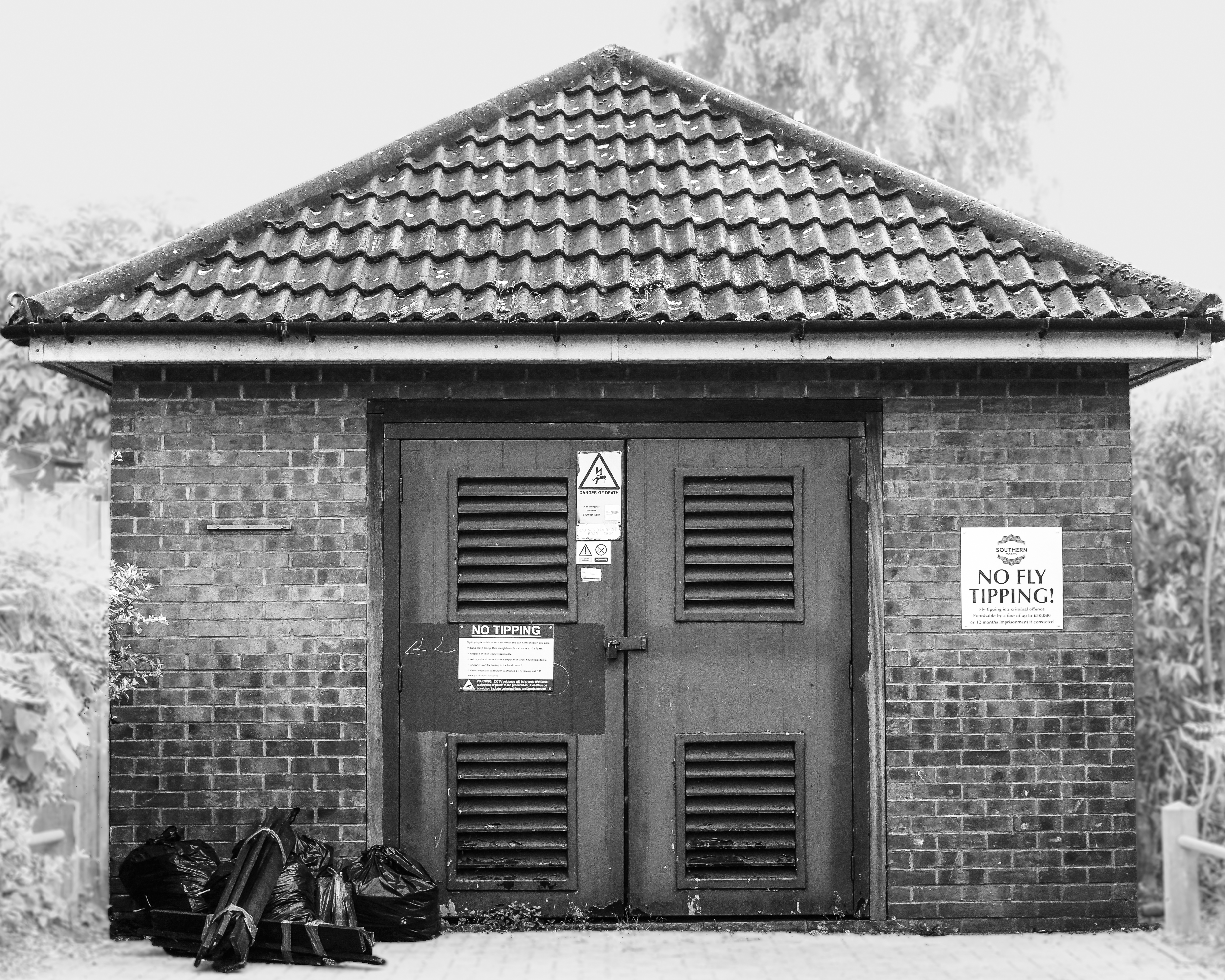
The substation on Christy Way (below) off Davidson Road is near the entrance of a small group of residential streets built in the early 1990s on the site of the former Woodside brickworks.
One of the most recent substations, built under the flyover Waddon New Road (below), was possibly built as part of the electricity supply for the modern tram system. Another, similarly clad in timber, can be found behind the Renaissance building 9-16 Dingwall Road.

Others appear to be housed in mass-produced metal huts, such as the one near Wandle Park tram stop (below), just one step up from a roadside cabinet. Another can be found on the Fairfield Footpath at Larcombe Close.

Sources
Anon. 1901. Electric Light and Traction at Croydon. The Electrical Review 49 (1245): 553-555.
Anon. 1978. Electricity Substation, Newmarket Street, Skipton https://historicengland.org.uk/listing/the-list/list-entry/1131853?section=comments-and-photos (accessed 26 May 2024)
Anon. 1981. Electricity Substation, Tooting Bec Gardens, London https://historicengland.org.uk/listing/the-list/list-entry/1357960 (accessed 26 May 2024)
Anon. 1983. Electricity Substation, Church Street, Runcorn https://historicengland.org.uk/listing/the-list/list-entry/1130437 (accessed 26 May 2024)
Anon. 1992. Central Timber Framed Arbour/Tool Shed, Soho Square, London https://historicengland.org.uk/listing/the-list/list-entry/1249910?section=comments-and-photos (accessed 26 May 2024)
Anon. 2017. Croydon Power Stations https://en.wikipedia.org/wiki/Croydon_power_stations#cite_note-:6-6(accessed 26 May 2024)
Anon. 2017. Infrastructure: Utilities & Communication. Listings Guide. London: Historic England.
Anon. 2023. Bernd & Hilla Becher. https://en.wikipedia.org/wiki/Bernd_and_Hilla_Becher (accessed 26 May 2024)
Brooker, R., 2013. The Dawning of a New Age. Croydon and the advent of its electricity supply 1881 – 1898. Croydon Natural history and Scientific Society Proceedings 19 (6): 213-286.
South Norwood Tourist Board https://southnorwoodtouristboard.com (accessed 26 May 2024)

 East Croydon Community Organisation