

This article was written by Lilian Thornhill in 1973. There is some information about Lilian at the bottom of the page.
“The schools were opened on 29th September 1873, as a result of the Education Act which required sufficient accommodation to be provided to make possible the compulsory attendance of the whole infant population of the country. Prior to this, the children of the neighbourhood could attend Lahore Road schools, run by the Wesleyans, at 3d a week, and there were several small private schools in Croydon. Ours was the second board school to be open; Brighton Road School, now Purley Oaks, started a few weeks earlier.
At first, there were four large schoolrooms, each occupied by a Head Teacher: Infants- Mrs Scott, Junior Mixed – Miss Mizen, Senior Girls Cross, and Senior Boys- Mr Kenningham. Pupil Teachers and paid monitors at 1/- a week were employed to help them, and it was customary to have two or three lessons going on at the same time in each of these rooms.
Although attendance was compulsory, each child had to play 1d a week. In spite of this the schoolrooms rapidly became overcrowded and there was not enough seating for all. Mr Kenningham complained of having 90 boys attending, with seats for only 64, and the rest had to sit on the floor. Extra classrooms were added from time to time and there must have been major rebuilding when each schoolroom had a second story added, yet within a year numbers were too great for comfort.
Times were hard in the 19th century and the early part of the 20th. There was no unemployment money, nor free medical attention, no sickness benefit, etc, and to fall ill or lose one’s job meant real hardship. Some children literally had no footwear, and second-hand boots, shoes and clothing was sent to the school for distribution to the needy. Working hours were long, wages very low and any pennies that could be earned by the older children most welcome. It may have been this that contributed to the poor attendance of many of the pupils. Girls were put into service at 12 years old, and Miss Cross received notice of fees rescinded for the girls who had never appeared at school. To judge by the school log books, the winters also were much harsher during this early period and heavy snowfalls kept many away. Young children were admitted at three years old but left school in October and were re-admitted in March. Sidelights on the times are given by entries in the log books concerning junior boys smoking pipes (cigarettes were not then fashionable among the working class), a boy stealing a 1/2d, spending 1/4d on a pencil, spending a 1/4d on dates (there were no children’s sweets either), and of accidents from horses and carts.
At first, of course, children were not used to the idea of school and whenever there was a counter-attraction such as horse racing at Woodside, visits of a circus to the town, fetes, Sunday school treats, etc, the schools were half empty. Not only were absentees a bane to the schools, but so were late comers. Registers had to be closed 10 minutes after the start of a session, yet many pupils arrived after this and their presence could not be counted. This was a loss to each school since only those pupils who showed a satisfactory percentage of attendance were allowed to sit for the annual exam. The results of this determined how much money the school had earned from the Ministry of Education. The fewer the children submitted, the less money earned from that source and the more to be found by the local board, so Head Teachers were under great pressure from the local inspectors. This was a scheme known as: “Payment by Results”.
The grant could be boosted by taking additional subjects and this was done here: drawing and singing were offered and brought in welcome increases.
Attempts to improve punctuality and attendance were made by offering rewards, at first of money, to the best five but these naturally went to pupils whose attendance was already satisfactory and did nothing for the hardcore. So cards were issued to reward pupils making 100% attendance each week. Five, later three, of these cards sent to the office via the school secured a prize – a book with the typical Victorian title such as “ Two Little Friends “, ”Little Clara’s Picture Gallery”, “Little Emma’s Picture Book “ etc., and awarded willy nilly to boys and girls alike.
The Infant School under Mrs Scott was particularly go-ahead and within a year of opening she and her Pupil Teachers were receiving instruction and experimenting with the new Kindergarten Methods. The Government Report stated that Kindergarten work was taught with remarkable skill and success; two demonstrations were given to other schools. Later in the century Mrs.Howse, Head of Girls, tried to introduce French but was forbidden to teach it either in school hours or out of them, probably because the School Board considered it would be educating girls above their station! There was a tremendous emphasis on the teaching of Scripture which was regularly examined by the local inspector, Mr Barrow Rule and even infants were expected to have learned long passages from the Bible and to know the Ten Commandments by heart. These and the Lord’s Prayer were pinned up on the wall of each schoolroom and commented on in the Log Book if damaged.
In the year 1891 free education was introduced and must have brought a sigh of relief from parents, children, and teachers! Woodside Schools were opened and some pupils transferred, but within three years Oval was again overcrowded.
In 1905 it was decided to keep the eight-year-olds in the Infant School and place the rest of the Juniors in the care of the Head Master of the boys, giving him a total of 354 boys and 138 girls. The Senior Girls continued as before.
The schools had more often than not achieved a very high standard for their day. Government Reports were most enthusiastic, and many boys won scholarships to Whitgift which only offered five annually in the nineteenth century. One year four of those places were gained by Oval boys. The staff were often ambitious and as many as five masters at one time were working for external degrees before the First World War. This war affected these schools, in common with all others, especially Boy’s Schools. When Davidson school was commandeered for use as an Army Hospital, some of its pupils were transferred here and to make room for them, the boys were sent to Tamworth Road Council School. Many of the masters volunteered for active service and three including headmaster Mr Sidney Beaumont were killed, as were many past pupils. The tablet on the south wall of the present school commemorates them.
The school itself was a war casualty too, a bomb falling on the Boys’ offices when a Zeppelin unloaded its cargo over Croydon on the 13th of October 1915. The schools were closed while repairs were carried out but there had been trouble with falling ceilings for some years and this incident did not improve matters.

After the War it was decided to reorganise the schools and from April 1921, there were only two departments -Infants and Juniors Mixed under Miss McLeod who had been a Pupil Teacher here at the turn of the century, and Senior Mixed under Mr George. I have been fortunate enough to contact one of the teachers working in the juniors at this time and she writes,… “ being the newcomer on the staff. I had room No.1 which meant that rooms 2 and 3 led off and so every time either of those classes wanted to go to P.E. or singing, they all trooped through my class. There was an enormous open fireplace surrounded by a stone curb and iron nursery guard by the door (which had a gap of about an inch worn at the bottom and the draught from the stone stairs leading up from the playground was nobody’s business. The only place for the blackboard was between the fire and the door so one had the option in winter of either being burnt or frozen. The desks – long forms with boards at the back and the front plain wood (no lift-up lid) – seated five and they were arranged in four tiers (on either side of a central gangway) so any bright spark at the back could slip down and slide through the legs of those in front. The windows were small and high up and the walls rough brick painted muddy cream at the top and dark green below. On a Monday in the winter, it was a common occurrence to find the ink in one’s inkwell frozen and that had to be thawed out before the register could be marked. The only advantage of being upstairs was that the rooms being small, the classes were only between 40 -45. In the “new” building I never had a class under 60. Our registers were considered more than holy – the attendance inspector used to come periodically and check the registers. He’d hold the book level with his eyes, up, to the lights and wagging his head up and down, would say in a sepulchral voice, “Miss Russell do I see an erasion?” Her salary was £132 per annum!
The rambling nature of the buildings, caused by the piece-meal additions, was such as to make organisation extremely difficult but in spite of this the school’s records both academically and at sports were good. George was himself an Olympic Runner. However, it was decided in the late twenties that the time had come to rebuild completely. The Infants and Juniors were sent to various church halls but the senior mixed was able to work in their old building which was to the east, where is the present playground. It must have been chaotic. For even when everyone was rehoused in the new building, the parts of the old just vacated had to be demolished and the playground made good. The official opening was on the 19th of February 1932. The ground floor was used by the infants and junior mixed and is also Handicraft Centre for the boys and a domestic centre for the girls. The seniors were on the first floor.

With the outbreak of the Second World War, the school was faced with evacuation. It was closed and parties of children went first to Brighton, later on to Camberley and Burley Salterton. When the expected bombing did not materialise, many children returned home and provision at school had to be made for them. There was a nucleus of evacuees left, which was augmented when bombing really started. The draft back after this had eased off, was almost complete but a new phase of bombings by doodle bugs ushered in a fresh wave of evacuations. The school building did not sustain damage but air raid shelters were built in the playground. School dinners were started as an emergency scheme to enable mothers to do war work, and the children had to walk under supervision to and fro from the Civic Restaurant, opened in a large house, now demolished, opposite the Leslie Arms.
The Education Act of 1944 made new schemes for Secondary education and since our site is too limited right adequate accommodation for Senior pupils in a separate building. It was planned to disband the Senior Department and the pupils were transferred to Tavistock or Davidson schools. The Infants and Juniors had increased in numbers to such an extent that already three of the upstairs classrooms had been made available to them. Extra children were sent from Davidson and the school settled down to its present set-up Juniors upstairs, Infants downstairs, overcrowding was soon so bad that a cloakroom had to be made into a temporary classroom and although that is no longer necessary, first half Juniors still use one wing of the ground floor.
Experiments in new aspects of education have been freely tried since the last war, both in organisation and content, and the curriculum now included the teaching of French by means of visual and aural aids, the Nutfield approach to Mathematics, English and Science and Television lessons. Much educational work is carried on outside the school walls by way of camping in France and at Pilgrim Fort and through visits to places of interest, exhibitions etc,
Sport has always taken an important place in the school, from the 19th century when Oval won the banner for several years running at the annual drill display, to the present when in spite of being handicapped through lack of training amenities. It is usual for the Junior school not to have at least one trophy on display for the year, one at football, netball, swimming, or athletics.

Everyone with whom I have been in contact has spoken of the happy atmosphere of the school. Obviously one cannot speak for the first 50 years but it’s certainly been one of its characteristics since the 1920s. It has been particularly fortunate in its Head Teachers and staff but the neighbourhood has also contributed something. Situated in a corner contained by the railway on two sides, it has, or has had some of the qualities of a village and its inhabitants have been by and large honest, hardworking, self-respecting people who are willing to cooperate when they understood what the school was trying to do for their children.
I’ve written this account to commemorate Mr Boxall’s long period in command of the school and as a tribute to his inspiring leadership. Much of it is based on information obtained from the Log Books which is made available to me and from which I hope to produce a more detailed account to mark the School’s centenary in 1973.”
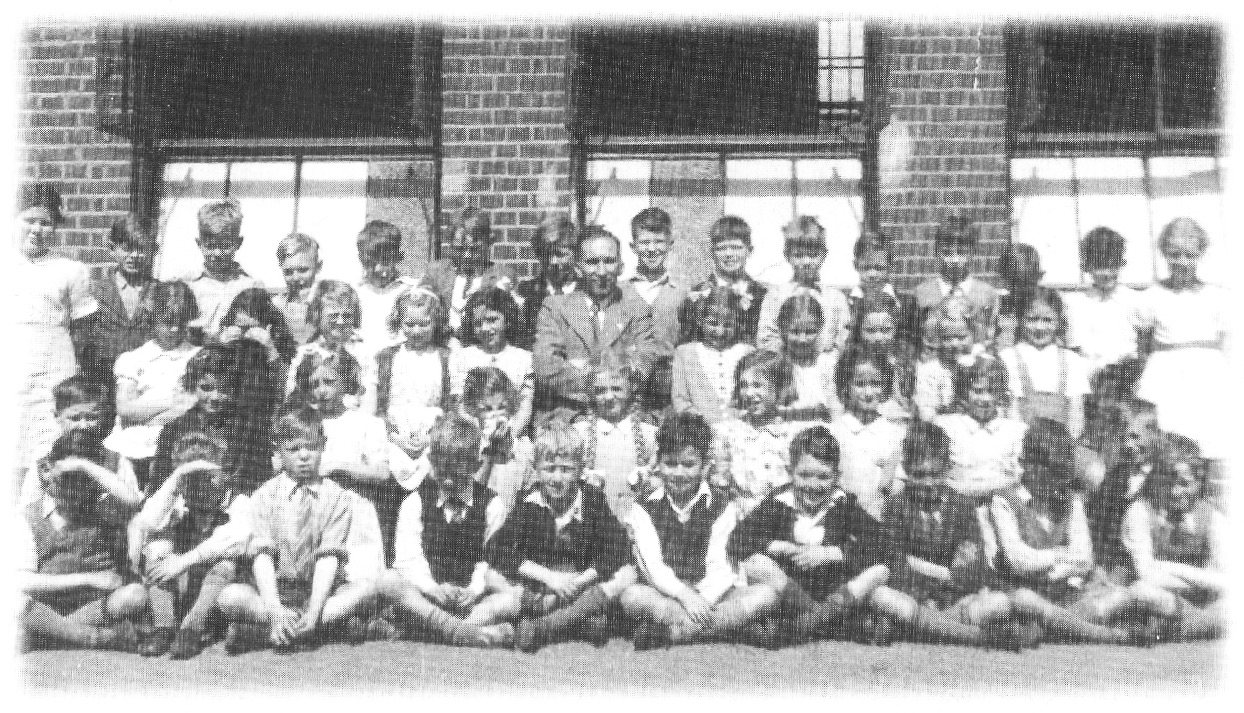
The photographs are dated (from the top) 1910, 1915, 1936, 1940s and 1950. They have been copied from
- Canning & Clyde Residents Association & Friends, 2000. The Book of Addiscombe vol 1 Tiverton: Halsgrove.
- Canning & Clyde Residents Association & Friends, 2002. The Book of Addiscombe vol 2 Tiverton: Halsgrove.

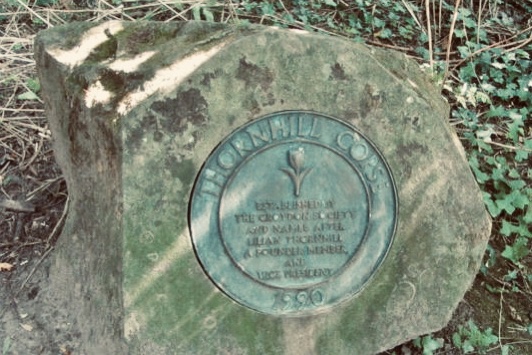
Lilian Thornhill was not only a much-loved teacher at Oval School, but she was also a leading figure in the Croydon Natural History and Scientific Society and the Croydon Society. A copse of trees was planted in her honour in Lloyd Park by the latter society. It can be found on the slope above the play ground, near the 12th hole of the disc golf course https://croydoncentralparks.wordpress.com/2021/09/01/the-copse-at-lloyd-park-spencer-road-halt/
 East Croydon Community Organisation