
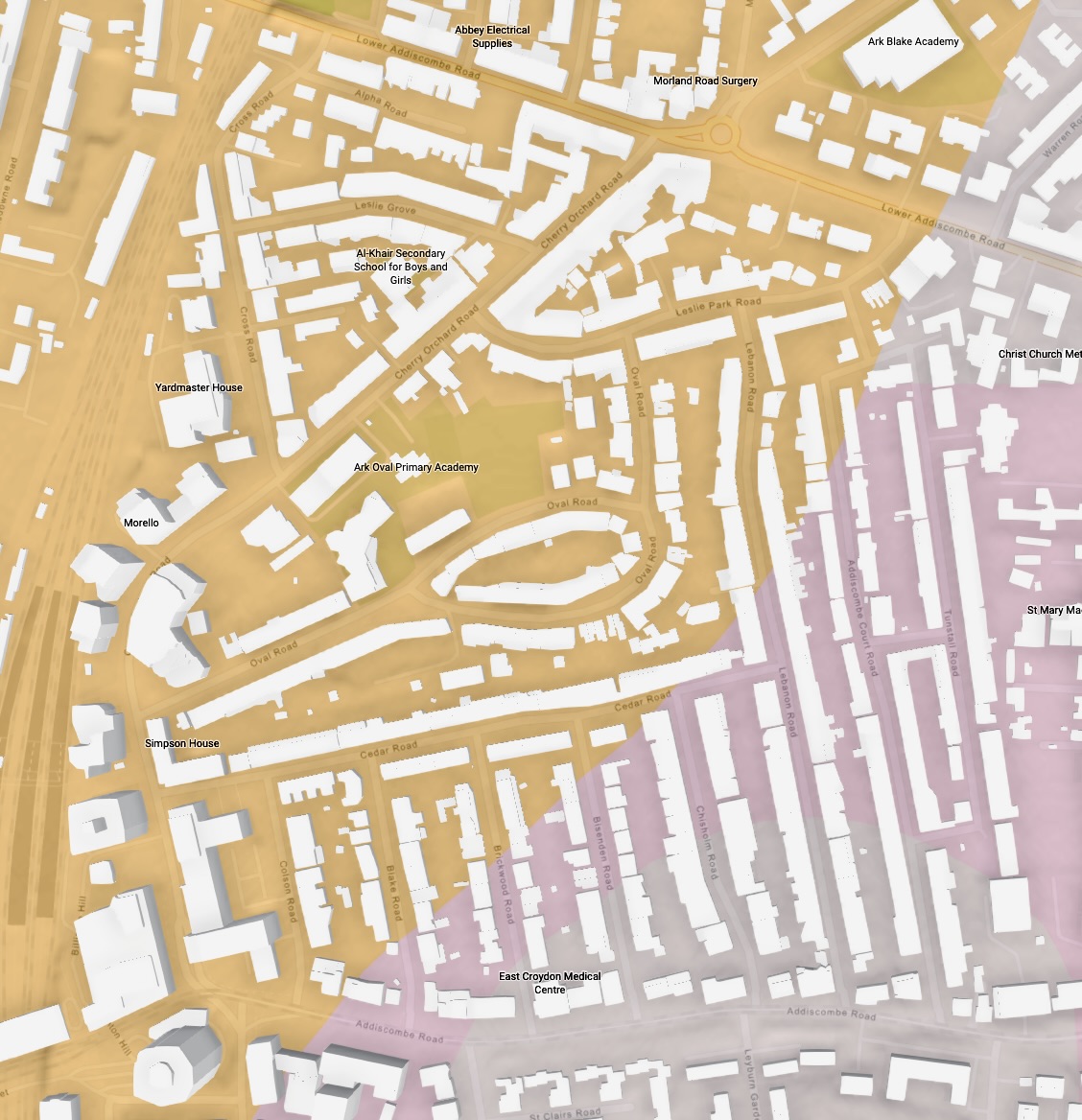
The geological map of East Croydon is made up of three elements
- superficial deposits (gold). Lynch Hill Gravel Member – Sand & gravel. Sedimentary deposits, fluvial in origin, ranging from coarse-to fine-grained. Beds and lenses of deposits reflecting the channels, floodplains and lives of a river or estuary. Quaternary – formed between 126,000 to 362, 000 years ago.
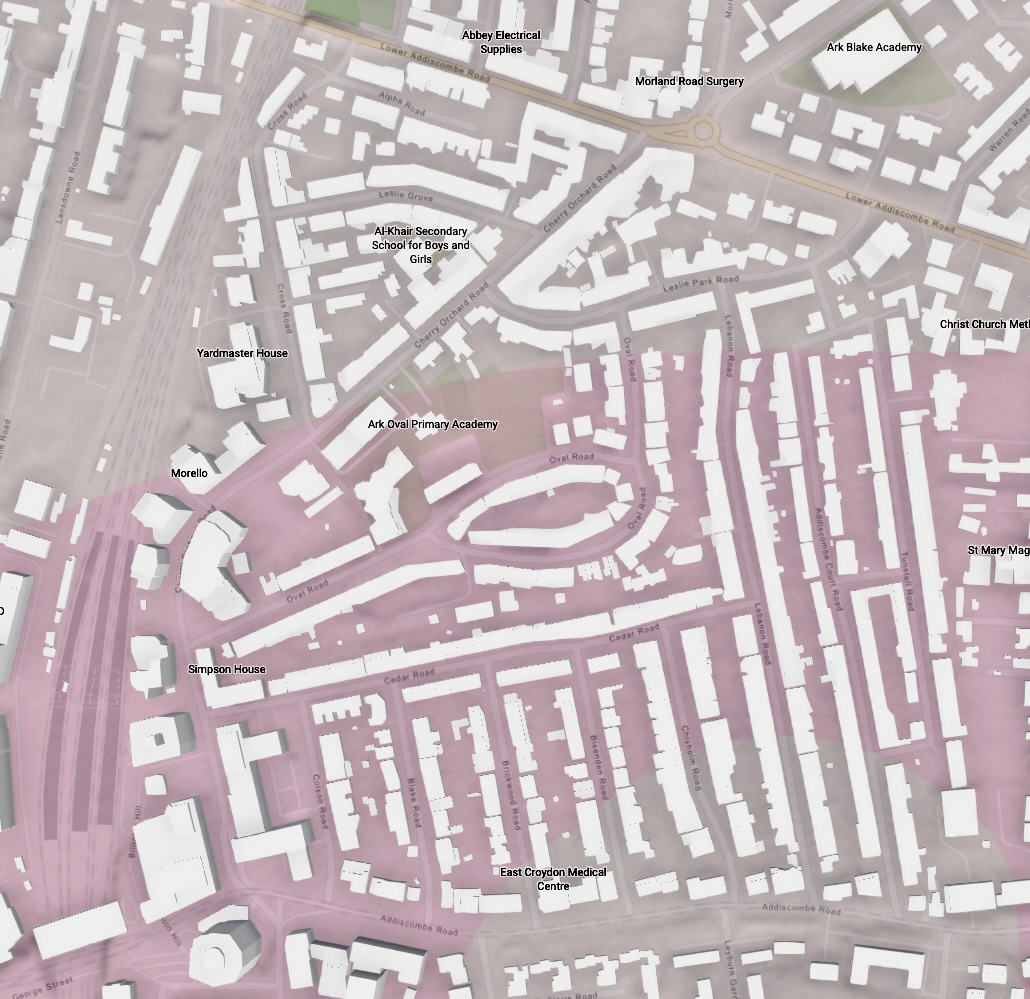
- bedrock geology (pink). Harwich Formation – sand and gravel. Sedimentary rocks that are shallow-marine in origin. Raining from coarse- to fine-grained (locally with some carbonate content) forming interbedded sequences. Palaeogene – formed between 47,800,000 – 56,000,000 years ago.
- bedrock geology (grey). London Clay Formation. Clay and silt. Sedimentary rocks that are marine in origin. Coarse- to fine-grained slurries of debris from the continental shelf flowing into a deep sea environment, forming distinctively graded beds. Palaeogene – formed between 47,800,000-56,000,000 years ago.
The Lynch Hill Gravel & Harwich Formation would have provided the gravels dug up by Hall & Co when they first moved into their premises on Cherry Orchard Road. Some of these would have been in the vicinity of Oval Road before it was laid out. This may explain why some houses in the road have deep basements, but others do not.
A Mr Hodgson was recorded as having a brickfield at Cross Road in 1850, presumably with access to the London Clay Formation. Before the development of paved roads, it was more convenient to dig and make clay for bricks as close to the building site as possible. Initially bricks were hand moulded & clamp fired, but by the 1860s brick moulding machines could turned out pressed bricks and kilns had replaced clamps.
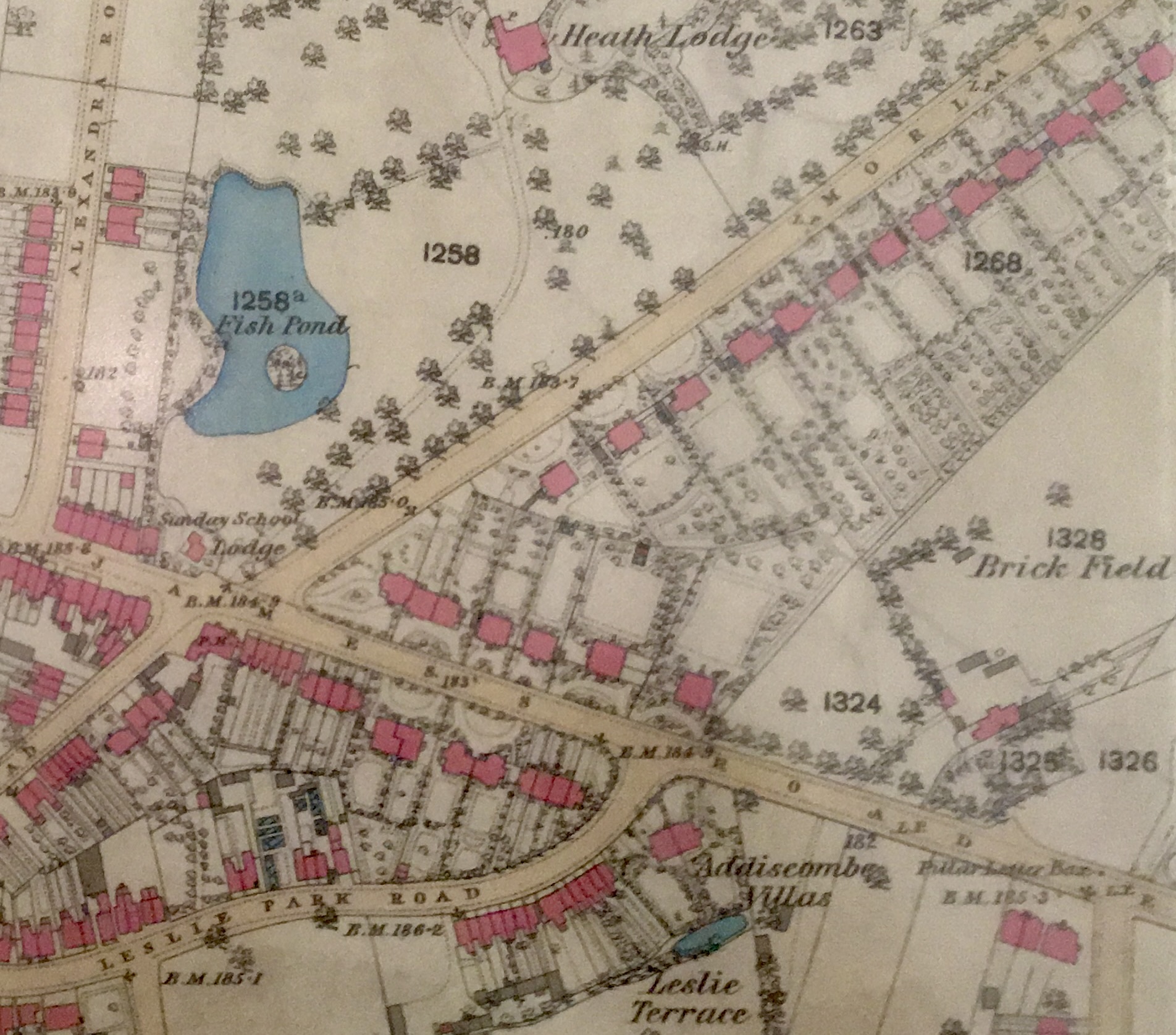
There was also a brickfield on the corner of Morland Avenue and Morland Road, owned by William Vaughan. He was a builder from London who built some houses nearby in the 1850s. This included Kirby Bedon, a house with a carriage approach, a library, a pigeon house and a tricycle shed when offered for sale in 1890. A block of flats called Kirby House is now on the site on Lower Addiscombe Road. The builder was himself commemorated in the name of Vaughan House, 11 Morland Road. When his brickfield was worked out, it became a fish pond. The pond, Kirby Bredon house and further brickfields on Warren and Hastings Road can be seen on the 1868 Ordnance Survey map below.
Written by Angela Vanegas with reference to the following sources:
- British Geological Survey https://www.bgs.ac.uk/map-viewers/bgs-geology-viewer/
- Cox, R. The Cherry Orchard Road area – talk notes transcribed by Tony Skrzypczyk, Autumn 2020. Croydon Natural History & Scientific Society Bulletin 169:58-76.
- Sowan, P., September 2012. Brick-clay, brick fields and brick making in Croydon. Croydon Natural History & Scientific Society Proceedings 12(5); 179-192.

