
By David Morgan as “From Grimaldi to Chaplin: Bult’s mission to record clown’s faces” . Originally posted on February 9, 2025 by insidecroydon
From his home at 26 Canning Road during the 1930s, Stan Bult set about recording and reviving the art of clowning. This Croydon man’s hobby turned into a major project which marked Bult out as a leading figure in the world of clowning and circuses.
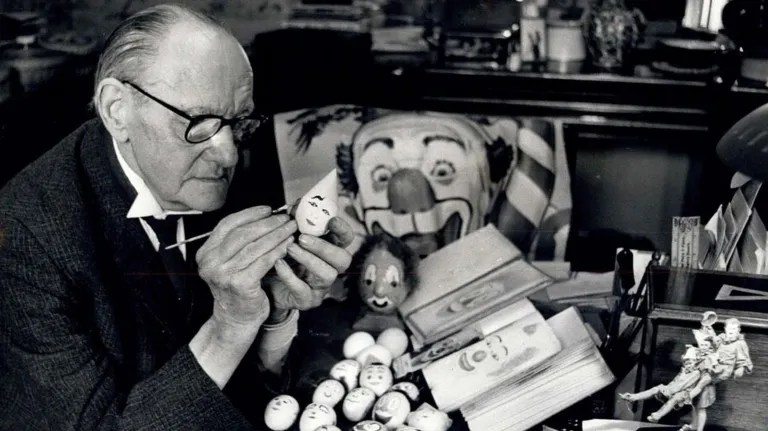
Bult was born in 1886. In the 1911 census he was working as an analytical chemist and was living in Addiscombe with his mother, five sisters and four brothers, all aged between 20 and 40. By 1921, he was still in Addiscombe, but at a different address, with his mother, one brother and three sisters. His occupation was given as a museum curator, probably the Museum at the Institute of Public Health where he was known to be working in the 1930s. For a while, before the Second World War, he was a magician and conjurer, prominent enough to become a member of the council of the Magic Circle.
It was thought that he got his love of clowning and circuses from the time when he lived in West Norwood as a boy. The Bults then lived next to the Bale family, who were circus performers to their roots. In the Bales’ garden was a stage where they practised trick cycling and acrobatics. Stan, the boy next door, became good friends with them and they introduced him to other clowns and circus acts.
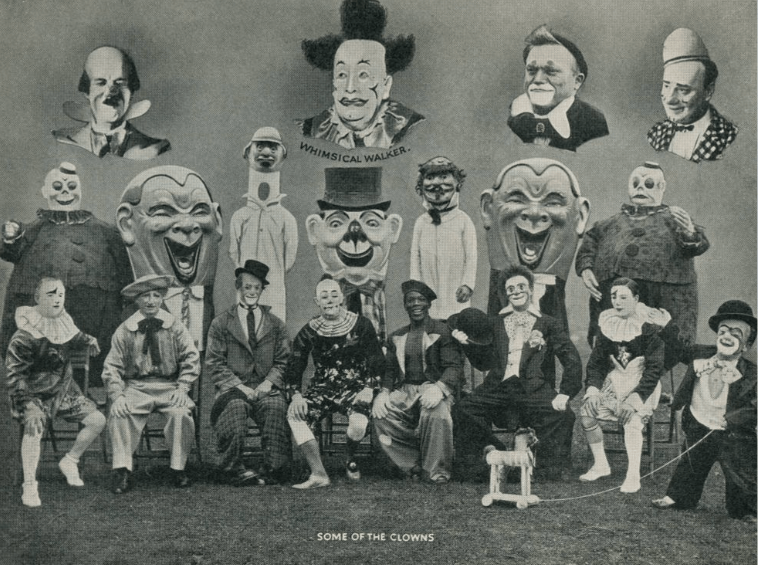
There is a convention in the circus world is that no two clowns could have the same makeup. The only exception was if a father retired from clowning, then his son (it was usually the son, never the daughter) could continue with the same visage. Every design of face paint was supposedly unique, to a single clown character. Bult began the task of recording clowns’ makeup. Using blown chicken eggs (though he was known to use larger duck or even goose eggs), he would painstakingly transfer the images on to the shells in the most delicate fashion, with fine-detailed brushes.
In 1947, Bult was writing a book on clowning when he was approached by the American clown Richard Arcand, known as “Cookie”, and asked to form a European section of the American Clowns Club. As a result, the International Clowns Club came into existence and Bult became the secretary of the European section. Members came from Britain, Sweden, Denmark, France, Germany and Spain, as well as America. It was a friendship promoting club with a benevolent fund aimed at raising the standard of clowning. Bult was the only non-performer in the group.
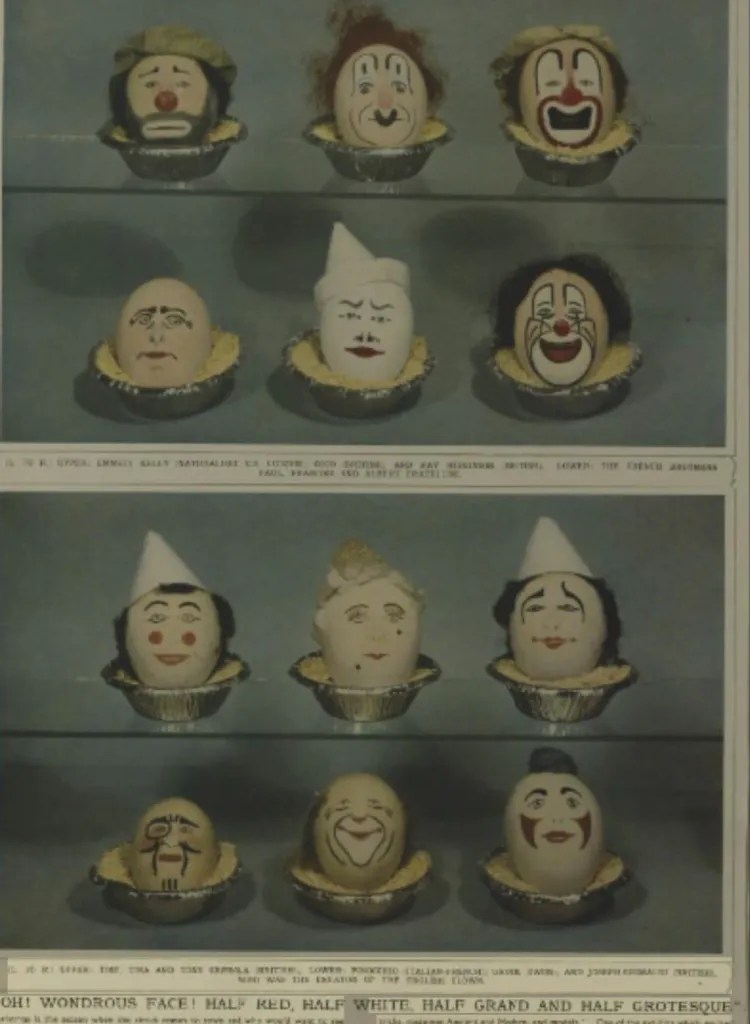
In an interview in 1956, Bult revealed more about his collection and vast knowledge of clowns. He had 377 different clown faces as drawings and he had painted 60 of them as decorated egg faces. Analysing these faces, Bult determined there were three categories of clown.
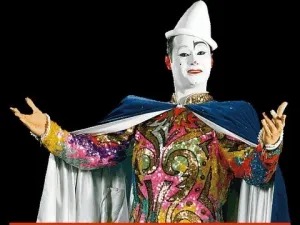
One was the white clown, or whiteface. Pasty-faced and dressed in fabulous costumes, often made from silks and sequins, and often with a large, ruffled collar and a pointed hat. The oldest of the clown archetypes, when whitefaces perform with other clowns, they usually function as the leader of the group. These glamorous clowns never got water thrown over them or took a custard pie to their face.
The second group were the auguste clowns, or red closen. These are well-padded out and wear clothes which were too big for them. The augustes are the ones who get the pies in the face, are squirted with water, are knocked down on their backside, sit accidentally in wet paint, or have their trousers ripped off.
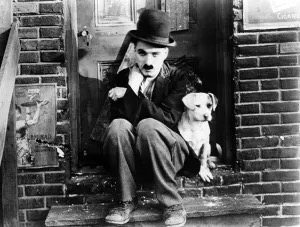
The third group were the droll clowns, or character clowns. They often appeared as broken down characters, sometimes wearing a collar and tie but with no shirt. They might have a sleeve of a jacket missing or wear spats but with no shoes. First in the silent movies of the early 20th Century, it was suggested that a sub-genre of the droll, the tramp or hobo, was created by comic actors such as Charlie Chaplin and Buster Keaton.
Bult felt great empathy for clowns who he thought didn’t always get the recognition which they deserved. He described entrée clowns as the kingpins of circus comedy. These funny men had a separate feature on the bill compared with the fill-in clowns who covered the scene changes. Bult admired those clowns who performed, or rather mis-performed, the acts of serious acrobatic stars.
A meeting was held in north London in 1953 where a dozen of Britain’s leading clowns discussed ways of improving clowning. Bult spoke to reporters afterwards saying that it wasn’t right that clowns should be expected to drive lorries or shift heavy poles. Manual labour “spoiled the nice hands of the clown and upset the nervous system”.
An advert in The Stage in December 1955 showed that Bult was still trying to complete as complete a database as he could have circus performers in Britain. He was asking for any Welsh circus performers to provide him with their details. The postal workers for Canning Road at this time must have been kept busy with Bult’s correspondence. Creating his database of performers, as well as his recording of clowns, was a mammoth task. Before the days of the internet, Bult relied on the post, together with some telephone calls, but without the modern conveniences of an answer machine, or photocopier.
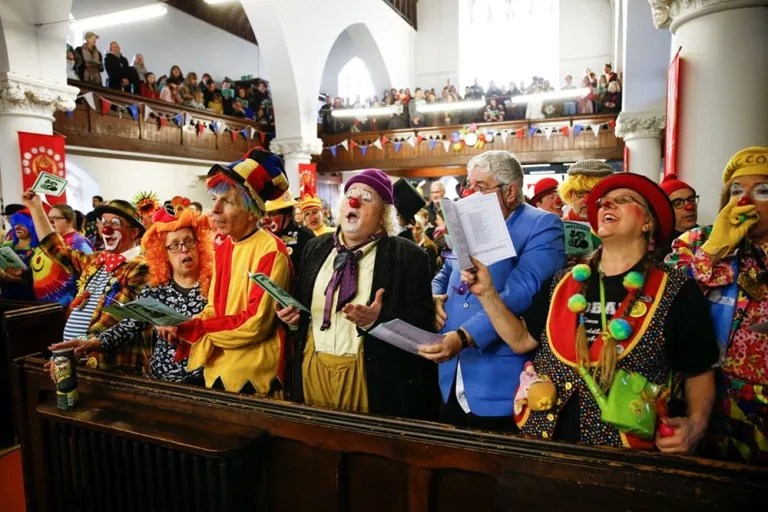
Bult was also responsible for helping to begin a tradition which has lasted for more than 80 years, the annual clown church service. He helped to set up the service at St James’ Church in Islington, where the “Father of Clowning”, Joseph Grimaldi, is buried. It was in rooms at St James’ where the first meetings of the Clowns Club were held. The church services, remembering Grimaldi and all other clowns, transferred to Holy Trinity in Dalston. Inside Holy Trinity was a memorial to Grimaldi, who had died in poverty. A wreath would be laid on it each year. Today the service is held in All Saints, Haggerston on the first Sunday of February.
Clowns of every age and nationality sang hymns with great gusto and entertained the congregation by telling stories from the Bible. The service also marked the passing of clowns past and present in their prayers, celebrating their artistry, commitment and friendship. After the service, which was open to all, there was a show for children and their families, together with plenty of clown cake.
The 1967 service, which was held in Holy Trinity Dalston, was the first one to be held without the presence of Stan Bult. He died in December 1966 at his home in Canning Road, Croydon. He was 80.
The then clowns’ padre Rev “Bill” Sergent, gave a special thanks for Bult’s £400 legacy – worth miore than £9,000 today. This was to be used to maintain the clowns’ portrait gallery in a permanent home within the church, which it did for many years. As part of the service there was a clowns’ blessing:
May your noses be red and shiny, and your smile always bright
May your cheeks be nice and rosy, your eyes sparkle in the light.
May your shoes be always too big, Your costume be perma-pressed
Your heart overflow with laughter, Every time your clown is dressed.
May face paint be at the ready, And your balloon be easy-blow,
May children run to greet you, Wherever you may go.
The clowns’ prayer also included the line: “As I stumble through this life, help me to create more laughter than tears.”
For many years, there was a clown museum in a room in Holy Trinity. It contained a huge number of artifacts, many of them collected by Bult. Sadly, after he died, the majority of Bult’s collection of egg faces was broken or lost. They had been loaned to a West End restaurant which then closed. The tradition almost disappeared but in 1979 it resurfaced, this time using ceramic eggs. About 300 examples, including 24 painted by Bult, are on display at the Wookey Hole museum in Somerset, originally set up by circus impressario Gerry Cottle.
The Circus Clown Club, which Bult helped to establish, is now known as Clowns International, with membership open to clowns of every type. They have continued to paint clown faces on eggs, including recreating some of Bult’s lost models, and they operate an egg registry. Which surely should be re-named a Regg-istry?
Not all people love clowns. Some find them scary. Caulrophobia is the word which describes the fear of clowns. Bult never felt that at all. His interest in and his joy of clowning shone through his life, when Croydon and clowning came together under his roof.
David Morgan is a former Croydon headteacher, now the volunteer education officer at Croydon Minster, who offers tours or illustrated talks on the history around the Minster for local community groups. If you would like a group tour of Croydon Minster or want to book a school visit, then ring the Minster Office on 020 688 8104 or go to the website on www.croydonminster.org and use the contact page
 East Croydon Community Organisation