
This article by David Morgan was originally published in Inside Croydon on 21 September 2025 as How Croydon’s second rink skated past Edwardian Nimbyism (with some additional, captioned images)
A documentary about the Edwardian roller skating craze (by the late Croydon historian Sean Creighton, can be found here https://media.nationalarchives.gov.uk/index.php/edwardian-rollerskating/
After the closure in 1881 of the first Croydon roller skating rink in Park L,ane, marking the end of Victorian Croydon’s “Rinkomania”, the town had to wait until 1909 for another to open. This one was at the junction of Cherry Orchard Road and Addiscombe Road, so not far from where that symbol of modern Croydon, the 50p-bit building, stands today.
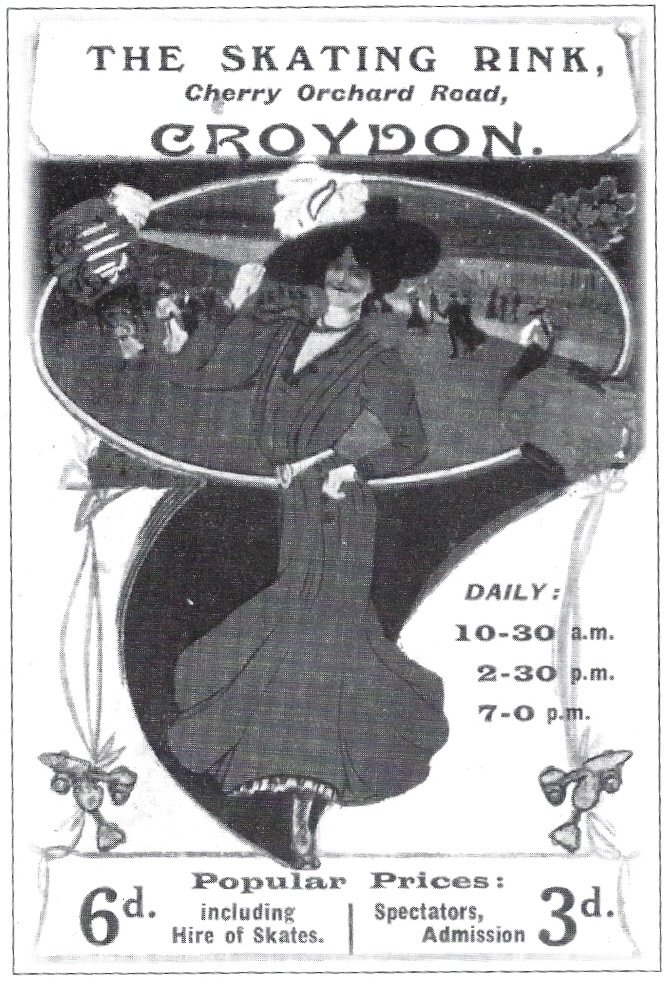
In June 1909, an announcement was placed in the Daily Express to say that 5,000 preference shares in the Croydon Skating Rink Ltd were to be offered to the public at 25 shillings each (£1.25 in modern money – worth about £190 today). The total capital of the company was £100,000, with half in preference shares and the other half in ordinary shares.
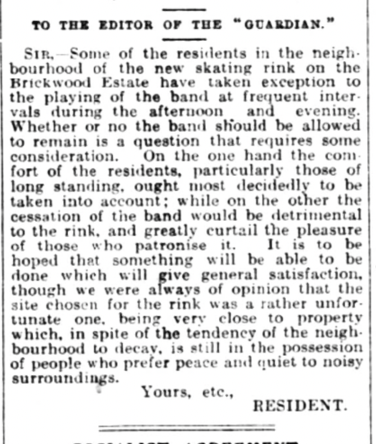
Nimbyism existed in Croydon even in the Edwardian period. People wrote letters to the local newspapers to complain about the noise and the location of the rink. In December 1909, someone living next to the rink penned a letter stating that “some of the residents have taken exception to the playing of the band at frequent intervals during the afternoon and evening skating sessions”. The writer argued that the rink’s location was a most unfortunate decision, putting it in a residential area where the householders preferred their peace and quiet. They understood why a band had been employed to play while the skaters were circling around, but questioned the need to have the music played so frequently. Or so loudly.
And then there was the meeting of the council’s licensing committee, which had to consider issuing a drinks and dancing licence for the venue. A King’s Counsel, hired to present the case for the rink’s licences, and two more lawyers were left kicking their heels in a side room during a three-hour council meeting. One councillor, after a visit to the rink, had agreed to introduce the three-man legal team at the meeting, but other councillors objected. There was opposition to the licences from the neighbours. In the end, the matter was referred to the General Purposes Committee, which seems to have granted the required licences for the business.
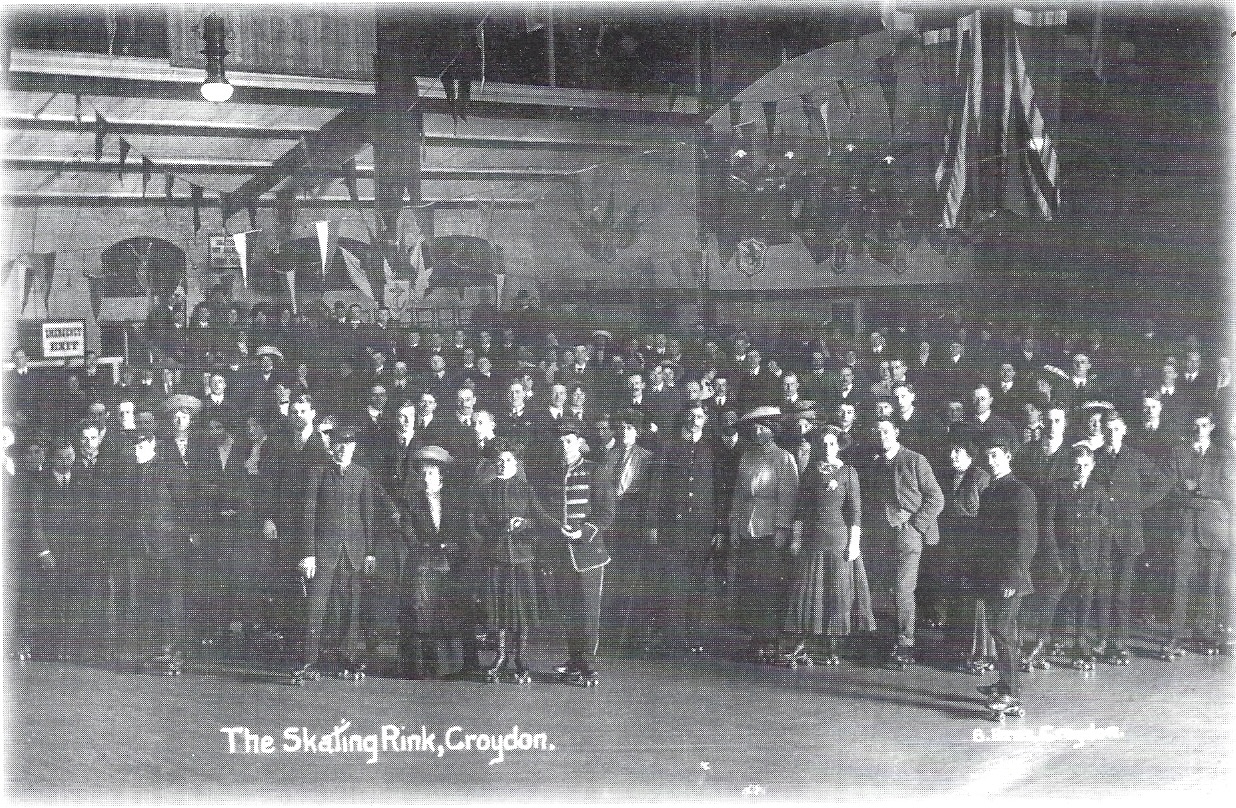
Although there were some hiccups in the early days of the rink, business soon settled into a pattern, with the skaters thoroughly enjoying their experience. The managing directors, a Mr Crawford and a Mr Wilkins, must have been doing a good job. By April 1910, advertisements for the rink showed that there were three sessions daily. By November, the venue was hosting rink hockey matches – what we know today as roller hockey. Hockey on roller skates was a popular sport back then, with the Crystal Palace Engineers rink hockey team winning the London Challenge Cup that year.
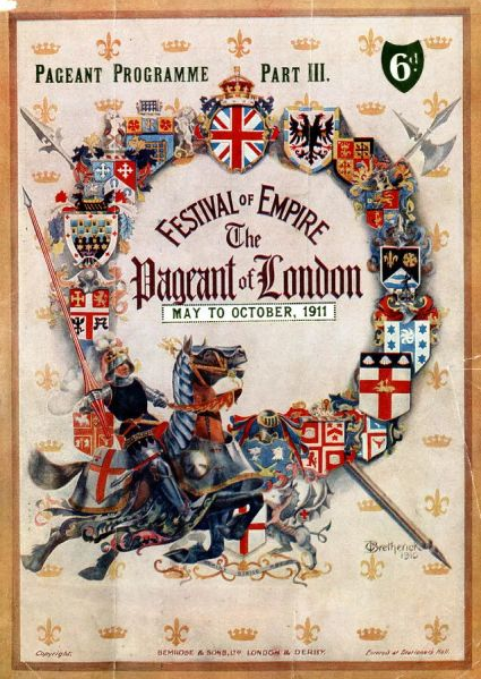
The Croydon rink was completely redecorated in the autumn of 1911, reopening in time for Christmas. The management wanted to make it Croydon’s most popular venue and produced an illustrated booklet as part of their advertising campaign. The new manager was the “genial” Jarvis Bell. The venue was also put to good use for other events. A large rehearsal was held at the rink for the Croydon section of the Festival of Empire. The six-month festival was the biggest event to be staged at the Crystal Palace since its opened almost 60 years earlier, and was staged to to celebrate the coronation of King George V in May 2011.
Lots of other events were held at Croydon’s skating rink. In February 1912, a Grand Fancy Dress Carnival was held. A Monday evening was chosen for the spectacular, perhaps because Monday was usually a quieter night. The entrance fee was one shilling (5p) and skating could go on until 11pm. All skaters had to wear either fancy dress or evening dress, but no masks were permitted.
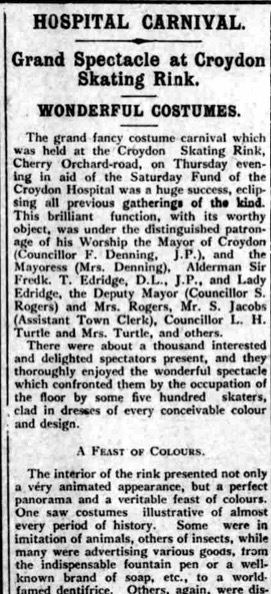
A piece in the local paper of March 1912 praised the facilities saying; “It was the most up-to-date skating rink in or out of London.” Perhaps the 15,200sqft of perfect maple flooring played a big part in that assessment, together with the quality of music from the military band. Even if people didn’t want to skate, they could always go to the Croydon rink to watch the others and enjoy the music.
Several of the events held at the rink were for charity. One of those was held early in 1914 to raise money for the Saturday Fund of the Croydon Hospital. One thousand people attended, with 500 of them skating. Everyone on the rink was to wear fancy dress. There was a “feast of colour” with people dressed in a whole spectrum of costumes with one of the most striking being someone dressed up as “the cup that cheers”, an early “Ovaltiney”! There were also Roman warriors, kings, queens and a motorist who carried a placard with the words, “Skate Slowly, 10 miles an hour speed limit”. The proprietor at that time was Mr WT Bolland and he was highly praised for his organisation on the night. A whole range of prizes were awarded. The gentlemen’s prize for the handsomest costume was a case of smoking pipes and was won by CV Knight. The “ladies’ prize” in the same category was a silver-mounted silk umbrella and was won by W Bennett. The 1st Croydon Girl Scouts, Lady Edridge’s troop, were thanked for selling the programmes and the posies of flowers.
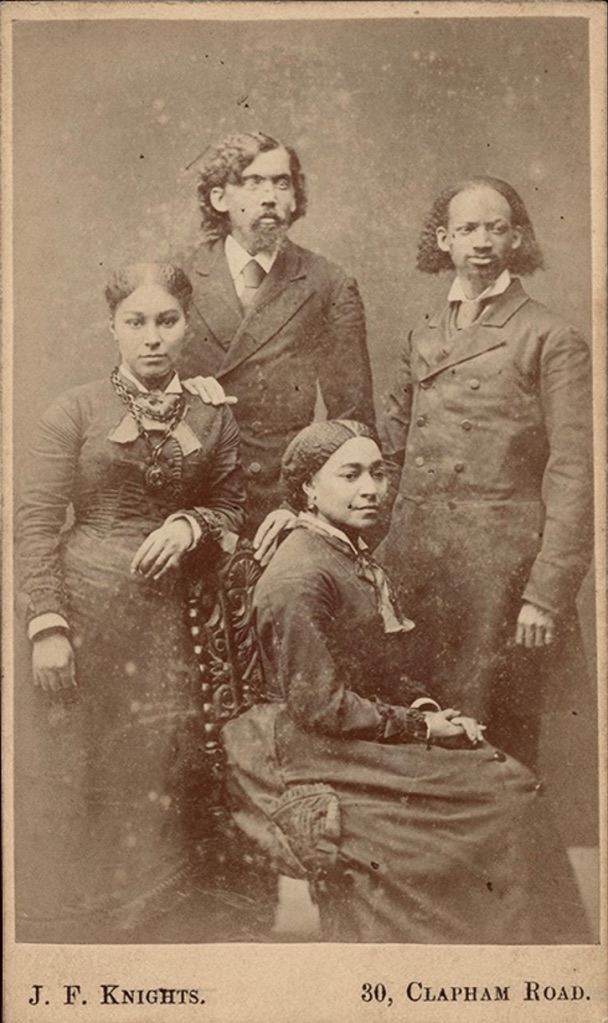
A Sunday School was held on premises for a time. One of the preachers who led some of those sessions was Rev Thomas Lewis Johnson, who had been a slave in Virginia for 28 years. He became a British citizen in 1900 was one of the first black students at Spurgeon’s College on Norwood Hill, the training centre for Baptist ministers. After serving as a missionary in Africa, Rev Johnson returned to this country after his first wife died. He remarried and settled in Bournemouth, from where he continued to preach and lead various church activities until his death in 1921. In his book, 28 Years A Slave, Rev Johnson recalled that two local women, Mrs Gawin Kirkham and Mrs J Johnson, who had both offered to put him up whenever he came to Croydon on business or to preach.
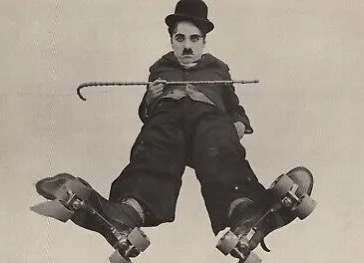
If you were in any doubt about the popularity of roller skating, its appeal reached all the way to Hollywood. Just watch Charlie Chaplin’s silent film, The Rink, from 1916. Here was the world’s biggest star of his time, born and brought up in south London, who certainly knew how to roller skate.
Croydon’s skating rink, though, was sold in February 1915. World War I was beginning to have an impact on the Home Front, but the Croydon auctioneers, King and Everall, reported that a very good price was paid for the site by the government telegraph contractors, Creed, Bille and Co. As part of that land deal, the parcel of land fronting the Addiscombe, Colson and Cedar roads was also was bought up by the government contractors. Creed’s Electrical factory was built on the site.
The people’s love of roller skating never went away, though. In December 1924, three young typists wrote a letter to the Croydon Times. “To encourage young people to spend their evenings and money in Croydon, why not open a roller skating rink? At present, one has to go to Brixton to skate now that the Norbury rink has closed. “We feel it would be a paying concern as we ourselves know many people who would only be too pleased to patronise a rink in Croydon rather than go elsewhere. Croydon is a large town but not so active as many small ones.” As we know now, the typists’ skating rink dream never became reality, though.
David Morgan is a former Croydon headteacher, now the volunteer education officer at Croydon Minster who offers tours or illustrated talks on the history around the Minster for local community groups. If you would like a group tour of Croydon Minster or want to book a school visit, then ring the Minster Office on 020 688 8104 or go to the website on www.croydonminster.org and use the contact page
 East Croydon Community Organisation