
Artists in glass who gave the Minster its windows on the world
Written by David Morgan
Posted on March 31, 2024 by insidecroydon
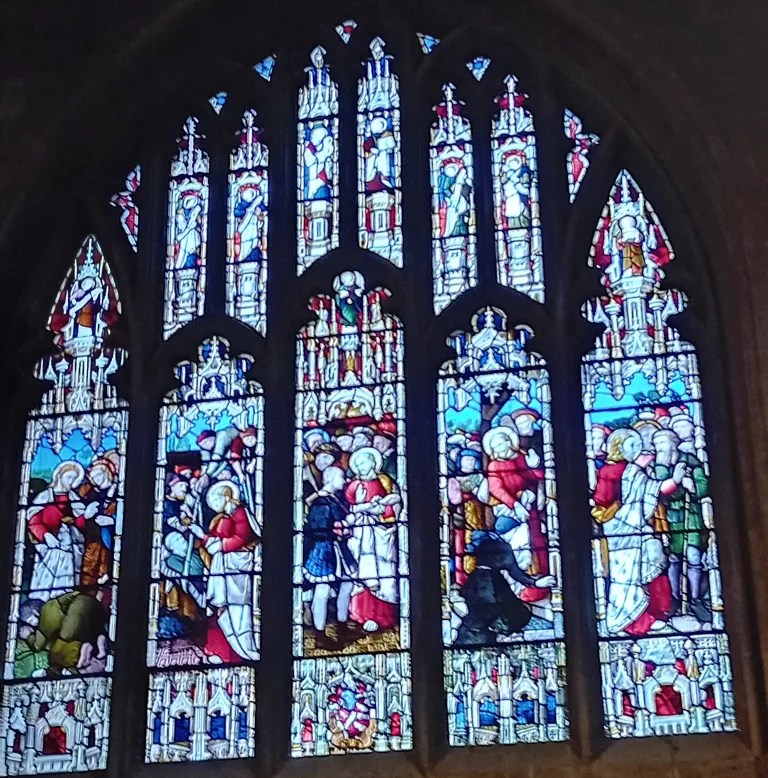
Five Miracles of Christ: this memorial stained glass window in Croydon Minster was completed in 1870 by Lavers, Barraud and Westlake.
Walking through Endell Street in Covent Garden recently, I noticed a plaque on a wall above a café informing passers-by that Nathaniel Westlake, a stained glass artist, had lived there in the 1880s.
Just a few metres along the road from the café I discovered a building on which there is some very intricate brickwork. Nowadays that building is used as office space, but above the first-floor windows, etched in bold lettering, can be discovered its original use: “Lavers and Barraud, Stained Glass Works”.
Here, on the north side of Covent Garden, was the site of one of the leading stained glass makers of the Victorian and Edwardian eras.
When Croydon Parish Church was rebuilt after the fire of 1867, the first stained glass window to be installed was the great east window. The contract for this was awarded to Clayton and Bell, based in Tottenham Court Road, another leading stained glass firm. This window was paid for by donations from people living in the parish. All the other windows in the church were filled with plain glass with the idea that over time, donors could commission windows in memory of a loved one.

Remembered: the plaque for Nathaniel Westlake in Covent Garden
The first of these memorial windows, dedicated to the memory of John Blake and paid for by William Bell, was designed and made in 1870 by the firm in Endell Street, then known as Lavers, Barraud and Westlake. This window in the St Nicholas’ Chapel depicts scenes showing five of Christ’s miracles. One of the striking features of the window is the glorious blue colour of the sky.
Nathaniel Wood Lavers had begun the business back in 1853, launching out on his own having previously worked for James Powell and Sons, the stained glass makers just off Fleet Street. Lavers was a craftsman and manufacturer and in his new business he employed freelance designers to create the pictures. One of these people was an artist named Francis Barraud who had also worked for Powell. In 1858, Lavers made Barraud a partner in the firm.

Memorialised: the fine old Lavers and Barraud Victorian glassworks, now used as offices
Nathaniel Westlake was employed by Lavers and Barraud, initially on a freelance basis, later that same year. Westlake was made a partner in 1868 and became chief designer, as Barraud felt his designs were not of a consistently high enough standard.
Francis Barraud had many connections to Croydon. He was married here in 1858 to Mary Towers and after she died in 1864, he remarried at Holy Saviour Church, St Saviour’s Road, to Mary Peck. In the 1871 census he was described as a 46-year-old “artist in glass” living in Addiscombe Road (now George St, where BoxPark is now) with his 26-year-old wife and four young children. They were well enough off to employ four servants. As well as his work in stained glass, Barraud was an artist in his own right. He usually painted in watercolour and produced some exquisite scenes of churches and colleges, notably one of Norwich Cathedral. He exhibited, too, at the Royal Academy. Barraud died in 1900, aged 75, at his home in Lavender Hill. He was buried in Queens Road Cemetery in Croydon, in grave number 827, where his second wife Mary would be interred in 1928. Just along from their grave lay Mary, Barraud’s first wife.

Expert: Nathaniel Westlake
Westlake brought a whole new dimension to the firm when he joined. He was very knowledgeable about the history of stained glass, writing four books on the subject. Westlake was able to use his knowledge of medieval art and couple it with a more simplified design for the windows. He was considered to be one of the very best artists of his day in this medium. He had, after all, just won a medal for his stained glass entry at the Paris Expo of 1867. He brought much new business to the firm and was the key factor in the large number of contracts they were awarded and in the critical recognition they received. Westlake continued to work in stained glass for most of his long life. By 1909 he was the only one of the trio still active and the business was then in his sole name. He died in Brighton in 1921 aged 88. With his death, the firm closed.
Four years after completing the window depicting the miracles of Christ, Lavers, Barraud and Westlake received a second contract for Croydon Parish Church.

Baptist on a plate: detail from the 1874 window in Croydon Minster, including the gruesome ending to the saint’s life.
In 1874, a window dedicated to the memory of John Wickham Flower was commissioned and paid for by his friend, John Peter. Flower was a well-known and respected antiquary who researched both locally and in Europe. Flower’s window today can be found in the St Nicholas Chapel, next to the Miracles of Christ. The subject of the window must have involved a great deal of discussion and agreement with the clergy, as it concerns John the Baptist, the saint to whom the church was dedicated. The old parish church was said to have chosen John the Baptist for its name because parishioners when the church was founded here, in Medieval times, would have been baptised in the River Wandle, running right outside the building. Since this window’s original installation in the church, it has been moved. It was originally placed on the north wall in the Lady Chapel, but is now in the chapel on the south side of the church. The shift would have occurred in 1893, when the organ was repositioned. The original position of the window is now just plain glass, although an inscription containing the initials “JWF” can still be read in the stone under the sill.

The Vision of Beatrice: possibly Westlake’s finest window, at the V&A Museum
The expert on stained glass in churches in Surrey is Robert Eberhard, who hosts a most detailed website.
Eberhard maintains that a third window on the south side of the church, showing pictures of saints together with scenes from the life of St Paul, is probably another one designed and constructed by Lavers, Barraud and Westlake. His conclusion was made after examining the design in detail after visiting the church. “It can be tricky to determine the artist as the windows constructed in the 1870s were generally not signed. This one isn’t. However, the design of it convinces me it is one of theirs,” he said.
Lavers, Barraud and Westlake didn’t just complete commissions for churches. Westlake’s designs were used in synagogues, too. In 1896, after Barraud had retired, the two remaining partners created windows for the hall of Mary Datchelor Girls’ School in Camberwell. Visitors to the Victoria and Albert Museum in South Kensington have an opportunity to see what was probably Westgate’s greatest creation in stained glass. This piece, named The Vision of Beatrice, is much admired for Westgate’s design and use of colour.
Stained glass windows are essential to the fabric of ancient churches, illuminating both the building and the people. Croydon Minster is full of classic Victorian stained glass. It took a fortunate discovery in a Covent Garden street to uncover some of the background to their creation.
 East Croydon Community Organisation