
Council consultation on traffic route changes around Addiscombe
The information below was written by Croydon Council’s Strategic Transport team on 2 November 2023. They are handling the “Healthy Streets” initiative which could, and probably will, impact heavily on some of the streets in the Addiscombe East and Addiscombe West wards. The project website can be found here https://www.croydon.gov.uk/parking-streets-and-transport/streets-roads-and-pavements/new-neighbourhood-schemes/new-neighbourhood-schemes/addiscombe-east-and-west
Introduction
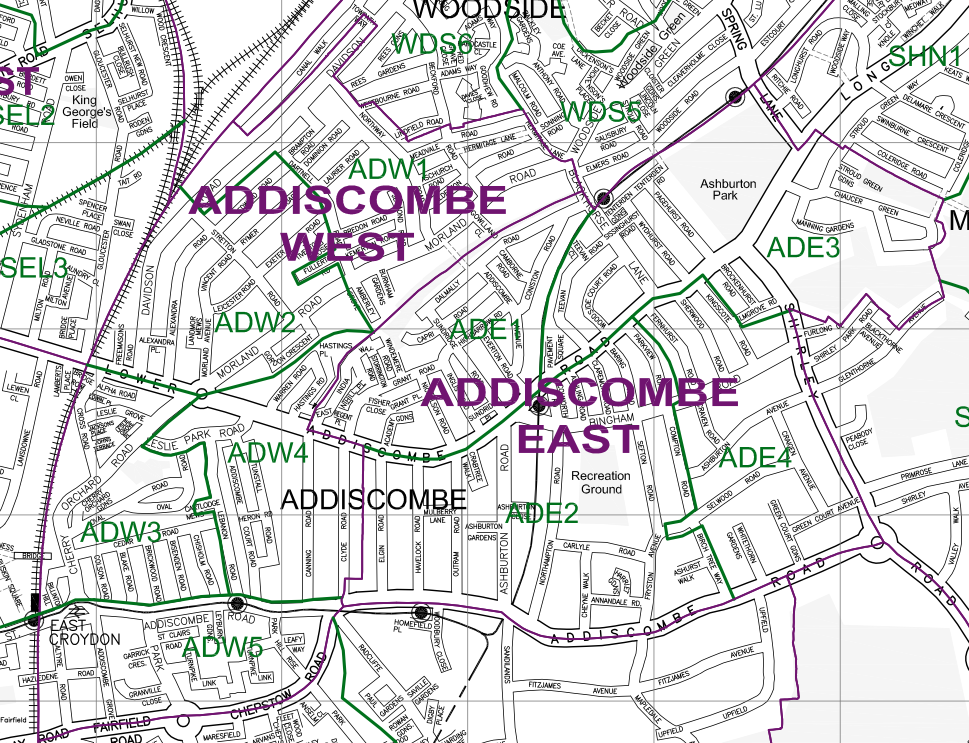
Making Lebanon Road one-way southbound in 2015 (to remove northbound commuter traffic and improve road safety) resulted in residential access streets adjacent to Lebanon Rd feeling the impact of displaced traffic. As a result, traffic management measures were introduced in Addiscombe Court Road and Canning Road in 2018. These measures caused traffic to be displaced to residential access streets within the HOME resident association area, predominantly Elgin Road (the next available northbound route for through traffic).
The Cabinet Member for Streets and Environment (and council officers) met with residents of Elgin Road to hear about the traffic issues they experience. The residential roads adjacent to Elgin Road (Havelock Road, Outram Road, and Ashburton Road) experience high levels of through traffic on a daily basis. There are other roads carrying high levels of through traffic such as Bingham Road, Sherwood Road, Fernhurst Road, Birch Tree Road and Northampton Rd in the eastern part of the area (as covered by ASPRA, Addiscombe and Shirley Park Residents Association) and Leslie Park Rd in the western part of the area (as covered by ECCO, East Croydon Community Organisation). The Cabinet Member for Streets and Environment (with council officers) also met with residents from ASPRA (Craven Road) to hear about the traffic issues they experience. Other residents from ASPRA have raised road safety concerns with the council and these will form part of the project going forward. Road safety & cycling will be key themes (in addition to through traffic) integral to this project and our partners will have an opportunity to raise any road safety concerns they may have at any time during the engagement process.
Officers have surveyed the volume and mix of traffic using many of the residential access streets, in addition to the main roads. Council officers will work closely with Transport for London (TfL) who are responsible for buses, trams and all red routes.
Engagement Approach
The approach to engaging with communities in and around Addiscombe East and Addiscombe West takes lessons from other neighbourhood projects. It will be about listening and working together. An initial list of engagement partners can be found at the foot of the page. The key principles underlying our approach are:
- Collaborative working We recognise the knowledge and lived experience of the local community and the value it can add in developing and delivering the right solutions which meet their needs. This means treating communities as equal partners, providing opportunities to participate in engagement activities including information sharing drop-in sessions and co-design workshops. Starting with a blank sheet of paper without preconceived ideas is considered important in building relationships, and achieving an outcome which will best meet local needs balanced with Transport for London priorities.
- Inclusivity Croydon is a diverse borough, and we recognise there are residents and resident groups who do not feel confident in coming forward when we deliver engagement activities. The challenge is to reach out to those who do not have the confidence to voice their views either in a workshop or meeting, or do not have access to technology. We recognise the value community groups and individual residents can add, and we will work closely with elected members and established community groups to reach out to other groups. Earlier pre-engagement conversations have happened with ward councillors and representatives from resident associations in the area. We need to reach smaller groups and individuals who may not usually engage or participate. We will continue to work closely with ward councillors and local groups.
- Involvement We recognise that local communities have a strong understanding of local sensitivities, community dynamics, and know how to engage with different community groups. Local community groups are adept at building networks to increase awareness and participation. It is important to recognise the level of skills that exist within a community group, their effectiveness in capturing, and drawing on different skills set within the local area to identify ideas and solutions. It is of significant benefit to a project if communities are encouraged to participate.
- Communication Plan We will publish a web page for the project to give partners, communities and individuals of information relating to the project, including dates and venues for engagement activities. This will be updated as we develop the project further to ensure we communicate progress. The web site will include a specific email address for the project for anyone who wishes to provide comment or raise concerns they may have about traffic and road safety.
- Monitoring Plan: We have drafted a plan to monitor the scheme after its implementation. We will share this with our partners and have discussions to inform the final plan. Once finalised we can post the monitoring plan on the council web page and also distribute it to all Resident associations for posting on their own web pages.
Engagement Plan October 2023 – July 2024
- Initial conversations We have started initial pre-engagement sessions with ward members from Addiscombe East and West. We have had meetings with representatives from residents’ associations (ASPRA, HOME, Canning & Clyde and ECCO) aimed at: building relationships and gaining trust, understanding concerns regarding current traffic issues and identifying other smaller resident groups to help ensure inclusivity. We will continue with our meetings with residents’ associations outside of the project area. We have explained the key role Transport for London (TfL) plays in this type of area-wide project (given their responsibility for buses, trams and managing red routes). We have discussed with representatives from residents’ associations how they might help the council sharing & distributing information to their wider networks using their communication channels.
- 23 November – 4 December 2023 Drop-in sessions are planned to present the information we have collected, to understand the traffic and road safety related issues being experienced; and explore ideas for addressing the issues.

- December 2023 We will work with all resident associations within the project area and adjoining it to develop a representative group to participate in the co-design workshops. This group can also feed back to their own community through their own resident association’s website and other means such as leaflets and emails. We will be developing the draft structure of the co-design workshops before Christmas and we will share this information with the residents’ associations and Ward Councillors early in the New Year. We will work with residents’ associations to discuss holding the co-design workshop on a Saturday with a pre-workshop session.
- Second week of January 2024: Pre co-design session It is very important to ensure those who attend the co-design sessions are informed about the structure of the session and the technical information we have. We will develop a briefing note for distribution to workshop attendees, and hold a pre–session one week before the actual session. Our technical consultants will outline their technical assessment, any outcome so far and answer queries. We will also discuss the structure of the workshop with Transport for London and share technical information (as appropriate).
- Last two weeks of January 2024: Co-design Workshop 1 An opportunity for our partners to identify ideas and develop solutions working with council officers. The workshop should include representatives from all residents’ associations within the area and adjacent to the area, working collaboratively to arrive at a set of solutions around which there is a level of consensus. There may not be solutions to resolve all concerns. The workshop is an opportunity to initiate discussions, share ideas and experiences, propose solutions and anticipate issues that may arise from them. We will also invite a representative from Transport for London.
- February to April 2024: Technical assessments The ideas from co-design workshop 1 will undergo technical assessments including understanding how they might affect other areas, main roads, buses and trams. These assessments will be carried in discussions with Transport for London (TfL). Given the nature and complexity of traffic assessments and discussions with TfL, we have made allowance in the programme to ensure we: conclude our discussions and carry out any potential revisions (balancing residents ideas & TfL requirements) prior to the second co-design workshop; adhere to the pre-election period for the Mayor of London & Greater London Authority elections.
- Last two weeks of May 2024: Co-design workshop 2 The results of the technical assessments and outcome of discussions with Transport for London will be presented together with mitigation measures to minimise or avoid wider impacts including to buses and trams. This will be another opportunity for our partners to have further discussions on the outcome of the assessments and work through other ideas if necessary. This is key to arriving at a degree of consensus around a solution or set of solutions in a transparent manner. The Council’s technical team will be at the workshop to facilitate the technical discussions and offer technical input.
- June 2024: We will make all necessary preparations to display the outcome of the workshops including area wide solutions, for a final presentation before seeking TfL and other formal approvals.
- First two weeks of July 2024: Drop-in sessions Aimed at presenting the final set of solutions following on from the workshops and ensuring all the relevant information is on display. There will be information on the next steps to develop the agreed set of solution forward, all relevant information will also be posted on-line for a wider reach and send to residents’ associations for their distribution.
- Third week of July 2024: Lessons learnt activity We plan to have a lesson learnt activity with those attendees who came to the workshops and anyone else who would like to participate. This is an important aspect of the project and can inform future engagement activities. We have not yet decided on how this could be done but will work with residents’ associations and Ward Councillors to do so.
- August 2024 and onwards We will seek all necessary approvals both internally and externally as appropriate and we will inform the rescinders’ associations as we approach this stage.
- Remainder of 2024/5 & early 2025/6 Implementation of the solution(s)/first solution. Integral to the implementation stage is a statutory process in line current legislation (Road Regulation Traffic Act 1984) and any formal objections/ representations received at this stage will need to be resolved prior to construction. However, the elements which do not require any statutory processes can be introduced ahead of those requiring statutory processes. We will discuss this with our partners.
Initial list of engagement partners (not exhaustive)
- Resident Associations: HOME, ECCO, Canning & Clyde, TACRA, ASPRA, Blackhorse and others
- Local businesses along main boundary roads
- Residents along main boundary roads
- Elected Members: Executive Mayor of Croydon, Councillor Roche (Cabinet Member for Streets and Environment), Councillors Bains & Henson (Addiscombe East Ward), Councillors Hay-Justice, Fraser & Fitzsimons (Addiscombe West Ward), Councillors Bennett, Chatterjee & Johnson (Shirley North Ward)
- Council officers from various departments
- Emergency Services (police, ambulance and fire brigade)
- Transport for London
- Schools within & around the project area and the school community
- Faith groups & disability groups within and adjoining the project area
- Active, Sustainable, Accessible Transport Forum
Croydon Cycle Group
 East Croydon Community Organisation